
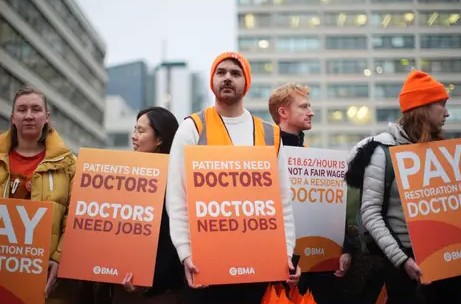
Prime Minister Sir Keir Starmer and Health Secretary Wes Streeting urged resident doctors on Friday to accept a deal and call off next week’s strike, as the NHS is battling a “super flu” outbreak.
In an opinion article in The Guardian, the Prime Minister wrote the NHS is at its “most precarious moment” since the coronavirus pandemic, with figures showing flu cases are at a record high for the time of year.
Starmer added that the planned strikes “should not happen”, putting the NHS and the patients who need it at serious risk.
I believe in workers’ right to strike.
— Keir Starmer (@Keir_Starmer) December 12, 2025
But the strikes next week planned by resident doctors should not happen, they place the NHS and patients who need it in grave danger.
A fair deal is on the table. My message to doctors is simple: take it.
Speaking to LBC radio earlier on Friday, Streeting said the NHS was facing its “worst pressure” since the coronavirus pandemic and urged resident doctors to take up the deal.
“The whole NHS team is working around the clock to keep the show on the road. But it’s an incredibly precarious situation,” he wrote in The Times. “Christmas strikes could be the Jenga piece that collapses the tower.”
Strikes will certainly disrupt operations and scans for patients.
— Wes Streeting (@wesstreeting) December 13, 2025
It is shameful that you and BMA leaders treat that so lightly – as if it is consequence free.
That’s our family, friends and loved ones waiting longer when they’ve waited too long as it is. https://t.co/oj9xERmE1i
Data released on Thursday showed flu cases are at an unprecedented level for this time of year after jumping 55 per cent in a week to an average of 2,660 patients in hospitals each day last week, up from 1,717 the previous week.
Under the new deal offered by the government, resident doctors could get 4,000 more training posts and royal college examination and membership fees covered, as well as prioritisation for UK medical graduates for training places.
The government has announced that no further pay increases are in the offing after resident doctors, previously known as junior doctors, received pay rises of almost 30 per cent in the past three years.
But the British Medical Association (BMA) says their actual pay has fallen by around 20 per cent in the past 17 years.
In a statement published on Saturday, the chairman of the BMA’s Resident Committee, Jack Fletcher, said the new proposal was a direct result of industrial action. “It should not have taken strike action, but make no mistake: it was strike action that got us this far,” he said.
However, he added that the proposal “does not increase the overall number of doctors working in England and does nothing to restore pay for doctors, which remains well within the government’s power to do.”
Union members are now voting on the new proposal. However, if the medical staff vote against the deal, the strikes will take place for five consecutive days starting at 7am on December 17.
Polls suggest public support for strikes is low, with a new YouGov poll showing 58 per cent of respondents somewhat or strongly opposed to the action, while 33 per cent somewhat or strongly supported it.
58% of Britons oppose resident doctors going on strike next week, amid health secretary Wes Streeting saying he's worried about the NHS being hit by a "double whammy" of flu and strike action
— YouGov (@YouGov) December 12, 2025
Support: 33%
Oppose: 58% pic.twitter.com/8xah5tWAB0
There is now a record number of doctors working in the NHS, but training bottlenecks are at an all-time high, with UK graduates facing intense competition for jobs due to a growing number of international applications, and in many cases being left out of work.
The previous government scrapped the resident labour market test, which required employers to first check whether they could find a qualified local person to do the job.
Medical school places have also been expanded in recent years without expanding postgraduate training, leading to increased competition for jobs. As a result, NHS-trained doctors are forced to compete on equal terms with doctors from around the world for NHS jobs.